
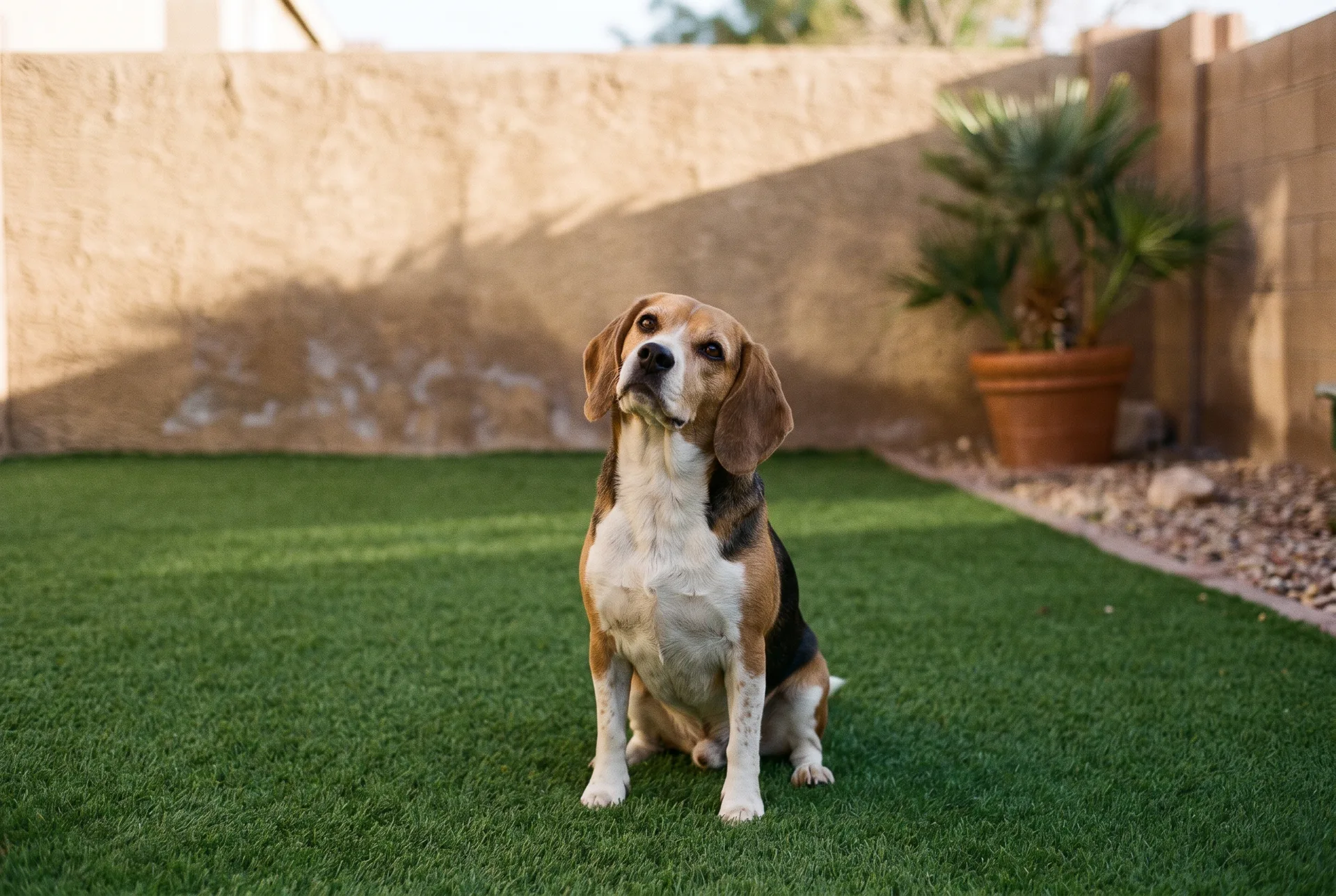
Artificial turf is everywhere in the newer Las Vegas master-planned communities. It saves water, always looks green, and requires no mowing. But when it comes to dogs, artificial grass presents a unique set of problems. If you treat synthetic turf the same way you treat a natural grass lawn, your backyard will become unusable.
The problem with plastic and heat
Natural grass cools the ground and contains natural microbes that slowly help break down organic matter. Artificial turf does neither. It is essentially a large plastic carpet laid over crushed rock or sand. In the Las Vegas sun, where summer temperatures easily exceed 100 degrees from June through September, that plastic gets hot.
When a dog leaves waste on this hot surface, it does not just sit there, it bakes. The moisture evaporates, leaving the solid waste hard and stuck to the blades. More importantly, the fine, invisible organic residue from the waste melts down the blades and settles into the porous backing of the turf. It is this trapped, baked-in residue that causes the overpowering odor that ruins so many local patios in July.
Step one: Complete solid removal
You cannot let waste sit on artificial turf for a week. The longer it sits, the more it bakes into the fibers. You need to walk the yard in a systematic grid and pick up every piece of solid waste, bagging it securely for the trash bin.
Do not try to mash or break up the waste, and never try to wash solid pieces into the turf. Any solid matter pushed into the backing will stay there forever, rotting and smelling.
Step two: The water rinse
Once the solid waste is completely removed, the turf must be rinsed. You cannot skip this step. Connect a hose to your working outdoor spigot and thoroughly spray down the areas where the dogs typically go.
The water pressure washes the fine organic residue off the plastic blades and pushes it down through the drainage holes in the backing. However, you must be careful, never use a pressure washer on artificial turf. High-pressure water will destroy the backing and displace the infill material that keeps the turf stable. Standard hose pressure is all you need.
Step three: Brushing against the grain
Heavy dog traffic and the weight of the rinse water will push the synthetic blades flat over time. Matted turf looks terrible and traps more heat. After rinsing, you need to use a specialized stiff-bristled broom to brush the turf firmly against its natural grain. This grooms the fibers, lifting them back up so the installation looks fresh and allows better airflow.
Step four: Applying a deodorizer
In the peak of a Las Vegas summer, picking up and rinsing is sometimes not enough. The residue trapped deep in the backing will still smell when the afternoon sun hits it. This is when you need a yard deodorizer.
We use a yard-safe enzyme and probiotic spray after the rinse on the same visit. The enzymes break down the remaining organic matter that causes the lingering odor. It is important to know that this is not a sterilizer, it will not kill bacteria or parasites like roundworm and giardia, but it will neutralize the smell. The turf usually dries in about twenty minutes, and then the dogs can go back outside.
Maintaining a schedule
If you have multiple dogs and a small turf yard, you really need to follow this routine twice a week. If you let the accumulation and the odor get ahead of you, bringing the turf back to a usable state requires a massive, labor-intensive deep clean.