
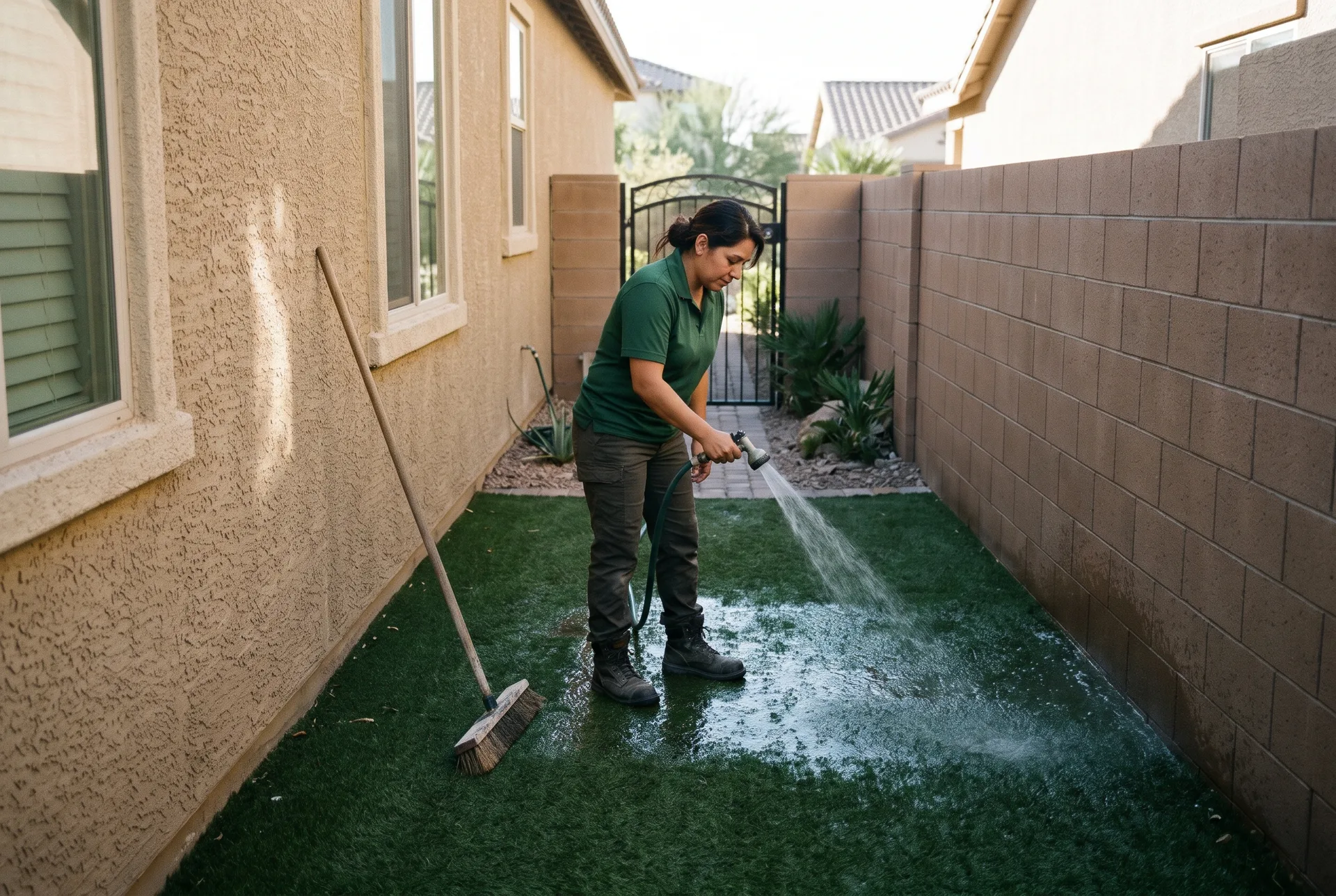
When the weather warms up in the Las Vegas valley, homeowners often complain about a sudden influx of flies swarming their patios and back doors. While the heat certainly plays a role, the primary attractant for these pests is usually sitting right on the lawn: uncollected dog waste.
Flies are not just annoying; they are a clear indicator that the sanitation in the yard has fallen behind, creating an environment that supports a rapid breeding cycle.
The breeding cycle
Flies are naturally drawn to the strong odors emitted by feces. Dog waste provides the ideal environment for them to lay their eggs because it offers both moisture and a food source for the hatching larvae (maggots).
In the warm spring and early summer months, a fly’s life cycle is very short. A single female fly can lay hundreds of eggs on a fresh pile of waste. Within 24 hours, those eggs can hatch into larvae, which feed on the waste before pupating and emerging as adult flies just a few days later. If you leave waste sitting in the yard for a full week, you are providing enough time and material for multiple generations of flies to breed right next to your back door.
The cross-contamination risk
A swarm of flies is a significant health hazard. Flies land on the bacteria-laden dog waste, picking up pathogens like E. coli and salmonella on their legs and bodies. When those same flies buzz around your patio and land on your outdoor dining table, your grill, or your skin, they transfer that bacteria directly to you.
Furthermore, dog waste often harbors parasites like roundworm and giardia. While the flies do not typically transmit these parasites directly to humans, their presence highlights the heavily contaminated nature of the soil in the yard.
Why sprays are not enough
Many homeowners try to handle the fly problem by spraying insecticides around the patio or hanging fly traps. While traps will catch the adults, they do absolutely nothing to stop the breeding cycle happening on the lawn.
Similarly, applying an odor-control treatment like our yard deodorizer will help neutralize the smell that initially attracts the flies, but it will not kill the eggs or larvae already present in the waste.
The effective approach
The only way to eliminate a fly problem caused by dog waste is to break the breeding cycle by removing the food source entirely.
You must establish a strict cleanup schedule. If you are dealing with a severe fly issue, a once-a-week sweep might not be enough, especially if you have multiple dogs. A twice weekly service schedule means that the waste is bagged securely and placed in a lidded trash bin before the fly eggs have a chance to fully develop.
By keeping the yard clear of accumulation, you eliminate the breeding ground, drastically reducing the number of pests and making your patio clean and usable again.